Tuesday, we added one more conversion, convert fractions to decimals and then to percents. So what is a percent? Percent is a comparison to 100. We have already learned to convert a fraction to a decimal, divide the numerator by the denominator (top in bottom out). To convert a terminating decimal to a fraction you say it correctly using place value and a repeating decimal you do the "9-Thing."
To convert a decimal to a percent you just move the decimal 2 places to the right and add a percent sign.
examples:
0.25 = 25%
1.5 = 150%
To convert a percent to a decimal you move the decimal 2 places to the left and take off the percent sign.
examples:
46% = 0.46
125% = 1.25
The hardest thing to remember is which way you move the decimal. We think about Dr. Pepper to helps us remember. Dr. Pepper means to change a decimal to a percent you move the decimal to the right D to P. To convert a percent to a decimal you move the decimal to the left which is P to D. You always move the decimal 2 places because there are 2 zeros on 100.
Students will have to give the missing values when given either the fraction, the decimal, or the percent.
Fraction Decimal Percent
3/4 .75 75%
1 65/100 1.65 165%
1 13/20
4/5 0.8 80%
Tuesday, September 30, 2014

Sept. 29, 2014 - Convert Decimals to Fractions
Monday, we learned to convert terminating and repeating decimals into fractions or mixed numbers. First, let's have some definitions.
terminating decimals - decimals that stop. They do not repeat. When dividing you have a remainder of 0.
examples: 0.25, 3.674
repeating decimals - decimals that repeat a number or series of numbers continually. To write a repeating decimal, you write the number or series of numbers that repeat one time and put a bar on top of the numbers that repeat.
__ __
examples: 0.5, 4.45
To convert a terminating decimal to a fraction you just say the decimal correctly using place value.
examples:
0.6 = 6/10 = 3/5
4.75 = 4 75/100 = 4 3/4
To convert a repeating decimal, where the entire decimal is repeating, you do what we call the "9-thing."
You put the decimal as the numerator and for each digit that is repeating in the decimal you put a 9 in the denominator.
examples:
__
0.5 = 5/9
__
0.63 = 63/99 = 7/11
___
5.363 = 5 363/999 = 5 121/333
terminating decimals - decimals that stop. They do not repeat. When dividing you have a remainder of 0.
examples: 0.25, 3.674
repeating decimals - decimals that repeat a number or series of numbers continually. To write a repeating decimal, you write the number or series of numbers that repeat one time and put a bar on top of the numbers that repeat.
__ __
examples: 0.5, 4.45
To convert a terminating decimal to a fraction you just say the decimal correctly using place value.
examples:
0.6 = 6/10 = 3/5
4.75 = 4 75/100 = 4 3/4
To convert a repeating decimal, where the entire decimal is repeating, you do what we call the "9-thing."
You put the decimal as the numerator and for each digit that is repeating in the decimal you put a 9 in the denominator.
examples:
__
0.5 = 5/9
__
0.63 = 63/99 = 7/11
___
5.363 = 5 363/999 = 5 121/333
Sunday, September 28, 2014
Week of Sept. 29th
This week we will begin discussing percents.
Monday - We will change continue with last weeks information of converting fractions to decimals and convert terminating and repeating decimals where the entire decimal is repeating.
Tuesday - We will introduce percents and convert our fractions and decimals to percents.
Wednesday - We will learn to calculate percent of a number focusing on sales tax, tip, and discount.
Thursday and Friday - We will begin solving simple 1-step equations with addition, subtraction, multiplication, and division.
Bonus Question of the Week:
On a piece of paper, copy this problem down and work it. Make sure you show all your work and that your answer has a correct label. Turn it in by Thursday, Oct. 2nd for 10 Bonus points.
Ryan transfers 15% of his monthly pay into a savings account. If Max makes $1850 per month, how much will he save in a year?
Monday - We will change continue with last weeks information of converting fractions to decimals and convert terminating and repeating decimals where the entire decimal is repeating.
Tuesday - We will introduce percents and convert our fractions and decimals to percents.
Wednesday - We will learn to calculate percent of a number focusing on sales tax, tip, and discount.
Thursday and Friday - We will begin solving simple 1-step equations with addition, subtraction, multiplication, and division.
Bonus Question of the Week:
On a piece of paper, copy this problem down and work it. Make sure you show all your work and that your answer has a correct label. Turn it in by Thursday, Oct. 2nd for 10 Bonus points.
Ryan transfers 15% of his monthly pay into a savings account. If Max makes $1850 per month, how much will he save in a year?
Wednesday, September 24, 2014
Wednesday, Sept. 24, 2014
Today, we will change fractions to terminating and repeating decimals. To change a fraction to a decimal you divide the numerator by the denominator.
. 6
_____
ex. 3/5 = 5 | 3 . 0 so 3/5 = 0.6
-3 0
______
0
The .6 is a terminating decimal because it stops with a remainder of 0.
A repeating decimal is a decimal number that repeats a single digit or group of digits.
__
ex. 1/3 = 0.3
When you divide 1 by 3 the 3 repeats. Once it repeats 3 times you can consider it to be a repeating decimal. You write the number of group of numbers one time and put a bar on top of the number or group of numbers that repeat.
We will also receive in class a list of 41 fraction to decimal equivalents to divide.
Click here for a list of equivalents that I want you to memorize.
We will also introduce the calculator to help with converting fractions to decimals.
Sunday, September 21, 2014
Week of Sept. 22nd
This week we will have our second test, Test 1-2. This test will cover operations with integers, mixed numbers, and decimals. We will review on Monday and then test on Tuesday. We are also supposed to have our first Pep Rally on Tuesday which will possibly modify our afternoon class schedule. If I feel the students will not have enough time to complete the test I may postpone it until Wednesday. If that happens I will just flip Tuesday and Wednesday's schedule on my calendar.
Wednesday, we will convert fractions to terminating and repeating decimals. The students will enjoy this day because we will also introduce the graphing calculators. The students will also receive a list of 41 fraction to decimal equivalents that I will want them to memorize. Don't worry, there is a trick to memorizing them.
Thursday, we will carry our fractions to decimals one step further, to percents.
Friday, we will begin finding percent of a number. We will be looking at sales tax and discount to teach this lesson. So next time you go shopping have your child figure what the sales tax might be on your purchase.
Bonus Question of the week:
The Rodriguez family went to dinner at Pasta Palace. Mr. Rodriguez ordered a meal for
$6.25; Mrs. R ordered a meal for $7.50; the 2 children ordered individual pizzas for
$4.99 each. The sales tax rate was 7.25% and they left a 15% tip. How much was the
total bill?
Copy the question, solve, and turn it in by Friday for 10 Bonus points.
Wednesday, we will convert fractions to terminating and repeating decimals. The students will enjoy this day because we will also introduce the graphing calculators. The students will also receive a list of 41 fraction to decimal equivalents that I will want them to memorize. Don't worry, there is a trick to memorizing them.
Thursday, we will carry our fractions to decimals one step further, to percents.
Friday, we will begin finding percent of a number. We will be looking at sales tax and discount to teach this lesson. So next time you go shopping have your child figure what the sales tax might be on your purchase.
Bonus Question of the week:
The Rodriguez family went to dinner at Pasta Palace. Mr. Rodriguez ordered a meal for
$6.25; Mrs. R ordered a meal for $7.50; the 2 children ordered individual pizzas for
$4.99 each. The sales tax rate was 7.25% and they left a 15% tip. How much was the
total bill?
Copy the question, solve, and turn it in by Friday for 10 Bonus points.
Saturday, September 20, 2014
Decimal Operations
Thursday and Friday we discussed decimal operations. This is something that the students should be good at because they have been learning decimals since 4th and 5th grade.
Addition and Subtraction
-There is one thing to remember when adding and subtracting decimals: line up the decimals. Along with that add zeros as place holders and add or subtract you numbers.


Addition and Subtraction
-There is one thing to remember when adding and subtracting decimals: line up the decimals. Along with that add zeros as place holders and add or subtract you numbers.
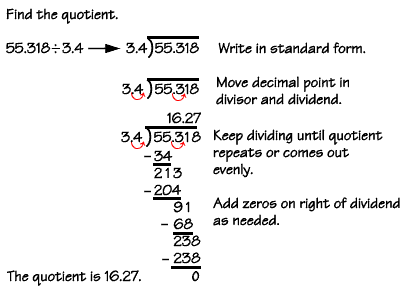
-To multiply decimals you multiply the numbers as though the numbers do not have decimals. Just line up your numbers and multiply. To determine where the decimal goes you count the numbers to the right of the decimal in each number in the problem. The sum is equal to the number of places you move the decimal to the left in your answer.
-To divide decimals you have to make sure your divisor (the number on the outside) is a whole number. If it is not you move the decimal to the right until it is a whole number. The number of places you moved the decimal in your divisor you move the decimal in your dividend, the number under the "house." Once you have moved the decimal in both the divisor and dividend you bring the decimal to the top and divide.
(Images taken from Google Images)
Thursday, September 18, 2014
Divide Fractions and Mixed Numbers
To divide fractions we first need to understand a reciprocal. Reciprocals are two fractions, that when multiplied, equal 1.

Examples:
Fractions Reciprocals
5 = 5/1 1/5
3/4 4/3 = 1 1/3
3 2/3 = 11/3 3/11
So you turn the number into a fraction if it is not already and then just flip it.
To help us remember how to divide fractions we learned a a little rap.
To De-vide fractions
Don't ask why
Just flip the second
And Multiply
To Multiply fractions
You know you've gottem
It's top times top
And Bottom times bottom.
If you would like to listen to the rap click here to here my class.
Here is an example of
Subscribe to:
Posts (Atom)