Thursday, September 11, 2014

Add and Subtract Mixed Numbers

Wednesday we began adding and subtracting mixed numbers with a slight twist, negatives.  We began class by discussing what a fraction looks like.  I had the students draw a picture of 5/8. I noticed that the students, for the most part, understand the true meaning of what a fraction is.  Here are the 2 correct answers out of 3 that they gave me:


A fraction is a part to total relationship.  5/8 means it takes 8 pieces to make a whole and I have 5 of them.

Next, we review the steps to add and subtract fractions.

1.  Find a common denominator
2.  Change your numerator to match
3.  Add or subtract your numerators
4.  Keep your new denominator
5. SIMPLIFY!!!!!

Then we moved to mixed numbers.  We added one step when adding or subtracting mixed numbers and that was to add or subtract your whole parts.  I like putting that step between step 4 and 5.

At this point I told the students we are finally ready to begin our lesson which was to add or subtract mixed numbers with negatives.  We did this problem:
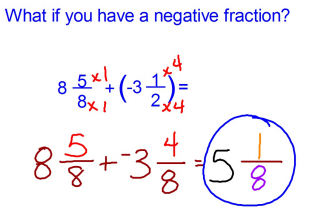

The students realized that you answer this question just like any other you just have to throw in your integer rules.

We will finish this lesson on Thursday.

Tuesday, September 9, 2014

Integer 4-Corner Model

Today, we began a small project.  Students are to create a 4-Corner Model with their integer rules.


In each section the students are to:
- Title the section (ex. Add Integers),
- In complete sentences, provide the rules to complete the operation,
- Give 2 examples of the operation.

In the center section, the students are to write a word problem using one of the operations.  The problem does not have to unique.  They can copy one from a previous assignment, find one in a textbook, or create one themselves.

Students can make this 4-Corner Model using paper like the image above, or they may choose their own medium, such as a Google Doc, Google Presentation, a Prezi, a Smore, etc. whatever they choose.

This project is due, if a paper copy, by the end of the day Thursday, Sept. 11.  If the project is digital they have until midnight Thursday.

Monday, September 8, 2014

Divide Integers

Today, we discussed the rules for division of integers.  The students found out that the rules for division are the same as the rules for multiplication.

There are 2 steps for dividing integers:
Step 1:  Divide your numbers
Step 2:  Count your negatives
   - If you have an even number of negatives your answer will be positive.
   - If you have an odd number of negatives your answer will be negative.

Examples:

24 / -4 = -6            -32 / -8 = 4

Tomorrow we will be working on a small project to help us better understand our integer rules.  Students will be able to create their project with regular paper, or they can create a digital presentation using Google, or a Prezi, or a Smore, etc.  More information will be provided in class tomorrow.

Sunday, September 7, 2014

Week of Sept. 8 - 12

This week we will finish our lessons on Integers.  We will discuss division of integers on Monday.  We will find out that the rules for division will be the same as the rules for multiplication.  We will also get our test back from Friday.  The results were not bad but there is still much work to be done.

Tuesday, we will begin a small project to help us review the integer rules.

Wednesday, the students will be happy that we will not have anymore lessons on Integers but they will find our that the rules will still apply to positive and negative fractions and decimals.  We call these Rational Numbers.  So Wednesday, we will discuss add and subtracting fractions and mixed numbers.  This should be a review.  We will see.

Thursday, we will examine subtraction of mixed numbers where you have to borrow from the first mixed number.

Friday, we will begin a 2 day lesson on multiplication of mixed numbers.

Friday will also be the end of the first 3 week period of school.  Expect to see a progress report first of next week.

Thursday, September 4, 2014

Test 1-1 Review

Today in class we completed a Test Review because tomorrow we will be taking our first test of the 2014-2015 school year.

The topics include:
-Writing an integer to represent a situation.
-Comparing and ordering a list of integers.
-Absolute value of a number
-Add, Subtract, and Multiply Integers

The students should have a copy of the test review with the correct answers, but if not here is a link to a blank review and here is a link to the answers to the review.

This question always comes up just before the first test of the year, "How do I study for a math test?"
Here are a couple of ideas:
- Print the review and try to work all the problems again.
- Read over your notes so that you can remember what they say without having to look at them.
- If there are rules to learn be able to quote them and apply them.
- Look back over old assignments. Work some of the problems we did not complete.

There are many ways to study besides these but this is a start.

Good luck on your test tomorrow.

Wednesday, September 3, 2014

Multiply Integers

Today we discussed the rules for multiplying integers.  We found out that to multiply integers we use two basic steps.

Step 1:  Multiply the numbers like you have in the past.  Pretend the numbers are all positive.

Step 2:  Count the number of negative signs in the problem.
     - If you have an even number of negative signs your answer will be a positive.
     - If you have an odd number of negative signs your answer will be a negative.

Examples:

6 x 3 = 18

-5 x 3 = -15        There is 1 negative so the answer is negative.

-7 x -4 = 28         There is 1 negative so the answer is negative.

-2 x 3 x -2 = 12          There are 2 negatives so the answer is positive.

-5 x -2 x -2 = -20        There are 3 negatives so your answer is negative.

-1 x -1 x -1 x -1 x -1 x -1 x -1 = -1         There are 7 negative signs so the answer is negative.

If you need additional instruction click here.

Tuesday, September 2, 2014

Subtract Integers

Today we discussed the procedure to subtract integers.  Ex.  15 - (-21) =  We determined that to subtract integers you really have to add.

We use a process of LCO+ to work a subtraction of integers problem.  LCO+ stands for:

L - leave the first number alone
C - change the subtraction sign to an addition sign
O - change the next number, after the subtraction sign, to its opposite
+ - revert back to your addition rules because the problem is now addition

Ex.  15 - (-21) =

       15 + 21 = 36

The 15 stayed the same.  We changed the - sign to +, and the 21 changed from negative to positive.  The signs of the new problem are alike so we add them together.

Additional examples:

Ex.   -6 - (-8) =                               -9 - 7 =

        -6 + 8 =  2                              -9 + (-7) = -16